
I do my scholarly reading, and much of my other reading, with codex books. This is not because I have some romantic attachment to the material heft and feel of books, as some converts to ebook readers and IPads are convinced must be the only reason people like me would stay with the codex. (Though it does make me pause to pick up the Bible that was passed down through my father’s family, published in Welsh in 1832, and ponder who has picked it up and read it before me. I feel a sense of connection 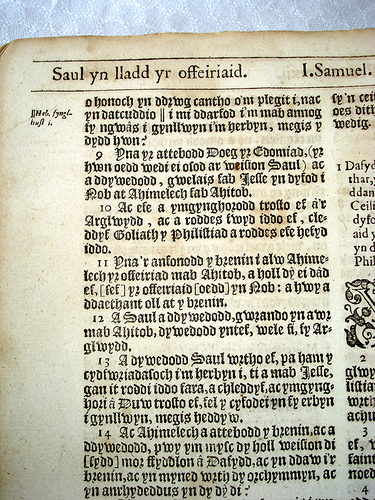 that material items, be they books or dishes or furniture can provide for us that, at least at this point, the rapid planned obsolescence of digital hardware seems unlikely to match.)
But the 1832 Welsh Bible, and the other old books I own, are part of my reason for being cautious about ebook readers for my scholarly work. I can read the books published 100 years ago, or 200 years ago or longer. But I have lots of digital material that is unreadable. Take, for example, the 5 1/4 floppy disks on which I wrote my MA thesis and my first short stories, which are now available for use as coasters. If I hadn’t printed those stories out, they would be lost. Of course I could also have moved them, time and again, to 3 1/2 disks, then to CDs, then to a hard drive or thumb drive, if I had remembered and not lost things along the way. But my point here, and I’m certainly not the first one to make it, is that digital technology changes very quickly and, if you’re not careful, you can end up losing material on which you have worked very hard.
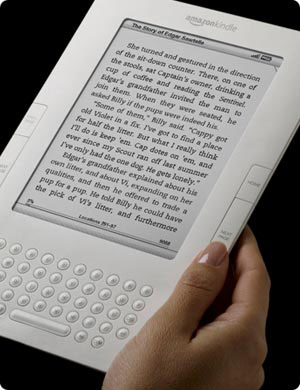 So, back to the Kindle (or Nook or IPad). I’m not at all against digital texts. I love being able to download journal articles and post them on to friends online. It is a HUGE convenience. But, when I have something I need to read, annotate, and keep, I print it out or buy the codex book. As a nerdy academic, I write a lot in my books. Questions, notes, summaries, ideas, rants, you name it. And I return to those notes, in those books, a lot, in both teaching and research. My problem with ebook readers then, is twofold. First, the annotation systems I have seen have yet to impress me as being as quick and efficient as my pen in hand — particularly not for someone like me with big hands and thick fingers. There is a reason I am not a surgeon (several, actually) and I have a very hard time with tiny buttons. But, even more to the point, I am unconvinced that the ebook reading technology I might use today (including annotating texts on my laptop) will necessarily be around 15 to 20 years from now. Unless I constantly move all my books and articles from one medium or machine to the next upgrade, I could lose them, with my notes in them.
  As someone who just the other day pulled a book off the shelf I hadn’t looked at in about 15 years, but found the notes and ideas and text I was looking for just when he needed them, I do not want to risk losing that material. What’s more, I don’t want to have to take the time to transfer the digital files when that time comes, or risk not having the software or hardware to read them.
I could be wrong, of course, and the ebook texts with annotations on them may last forever. Yahoo, I say. I hope it’s true. But I can’t risk it for now. So, for now, I read codex books, not primarily for sentimental reasons, but for desperately practical ones.
Oh yeah, one more thing. I’m really clumsy, or absent minded, or both. I drop things, particularly books, all the time. I’m hard enough on cell phones. My finances rejoice at the idea that at least books bounce.


 Bronwyn T. Williams